

Find the 2024 result of our carbon footprint and our commitments
Why carry out a GHG assessment?
According to the definition of ADEME (the French agency for ecological transition), a GHG assessment is an evaluation of the quantity of greenhouse gases emitted (or captured) into the atmosphere over a year by the activities of an organization or a territory.
Altyor has chosen to carry out its GHG assessment on a voluntary basis in order to understand the impact of our business and to know the effective levers to reduce our footprint.
A carbon footprint analysis can be performed on one or all three of these categories (scopes):
Direct emissions
Scope 1
Scope 1 covers greenhouse gas emissions directly related to the company and its activities from fixed or mobile installations (e.g. gas heating in the plant, fuel combustion in vehicles under its control, etc.)
Indirect energy related emissions
Scope 2
These are mainly emissions related to the production of electricity, heat or cold due to the company’s activities but produced elsewhere.
Other indirect emissions
Scope 3
Scope 3 includes all other greenhouse gas emissions that are not directly linked to the manufacture of the product, but to other activities upstream and downstream of the organization’s value chain (employee travel, fixed assets, investments, use and end of life of products, etc.)
“Some players are focusing on analysing their scope 1 and 2.
At Altyor, we believe that it is imperative to focus on all three scopes, in order to implement a low-carbon strategy for all three.”
 Altyor Président
Overall result of the Altyor carbon footprint
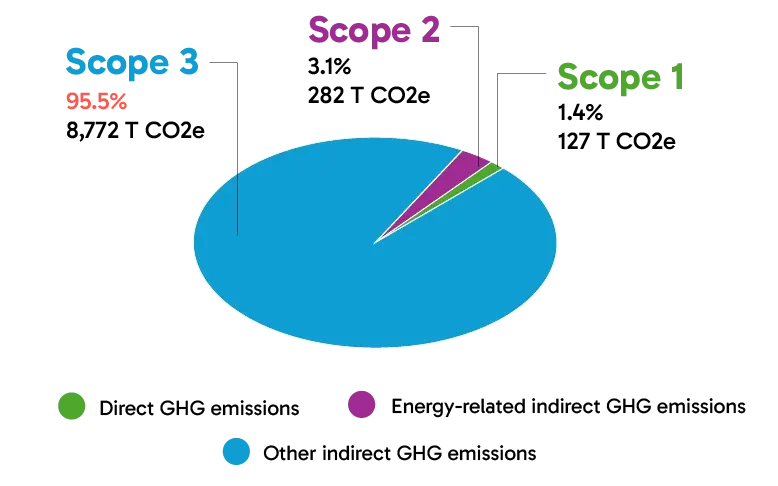
Scopes 1 and 2 together account for 4.5% of our GHG emissions. Scope 3, relating to indirect emissions, is therefore of major importance, accounting for 95.5% of our emissions, or 8,772 tonnes of CO2e.
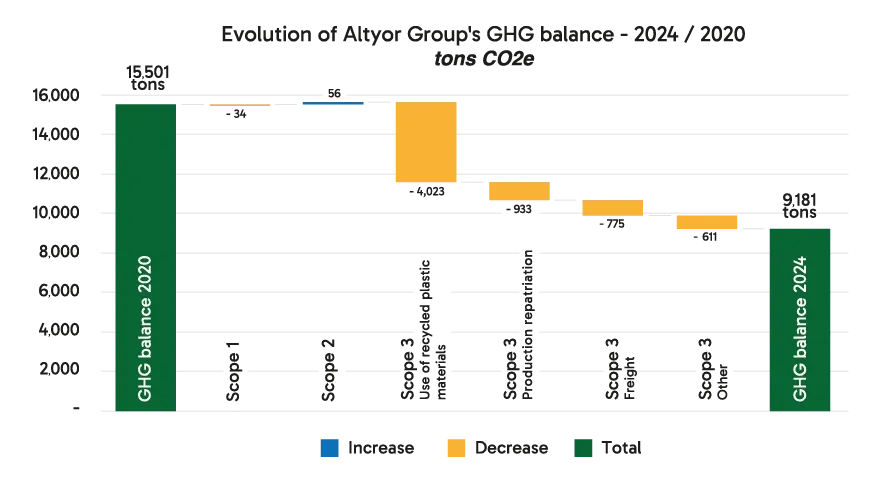
Between 2020 and 2024, we will have reduced our GHG footprint by 41%. This significant reduction is due to two main factors. Firstly, the accelerated use of recycled plastics has enabled us to significantly reduce our scope 3, representing 4,023T CO2e between 2020 and 2024.
In addition, the last two years have seen the repatriation of production to less carbon-intensive locations, representing 933T CO2e.
These far-reaching actions have enabled us to reduce our scope 3 emissions by 42% in 4 years, allowing us to reach our SBTi target for this scope 7 years ahead of schedule. ahead of schedule. We are continuing our efforts to further reduce our environmental footprint and surpass this figure.
Focus on scope 3
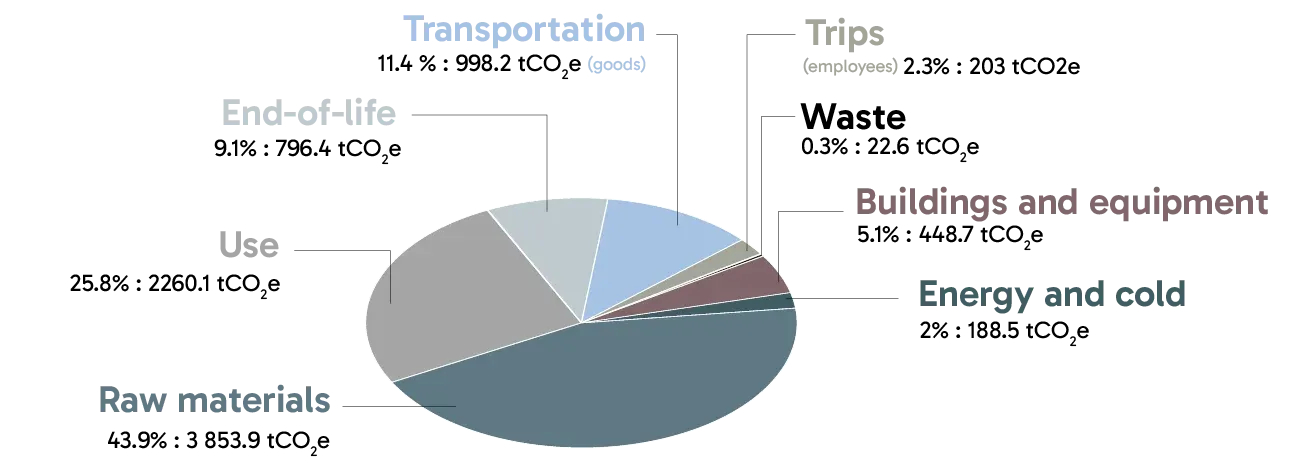
Altyor’s GHG emissions come mainly from the materials we use in our products (43.9%). Other contributors are the transportation of the products we manufacture, the energy used to manufacture them, their consumption (fossil fuels, electricity, etc.) during use, and the energy cost of their end-of-life.
Focus on raw materials
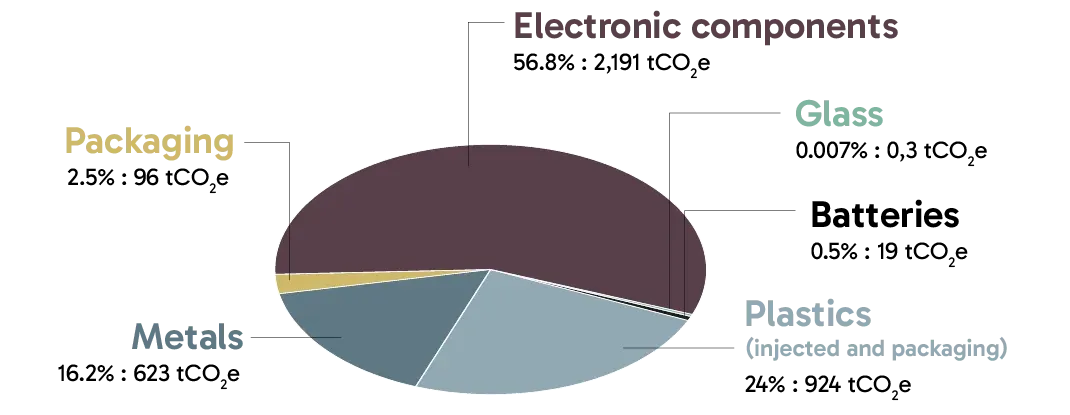
Plastics (injected and packaging) account for 24% of Scope 3 material emissions, or 924 tonnes of CO2e. Electronic components account for 56.8%, followed by metals at 16.2%.
Focus on transportation
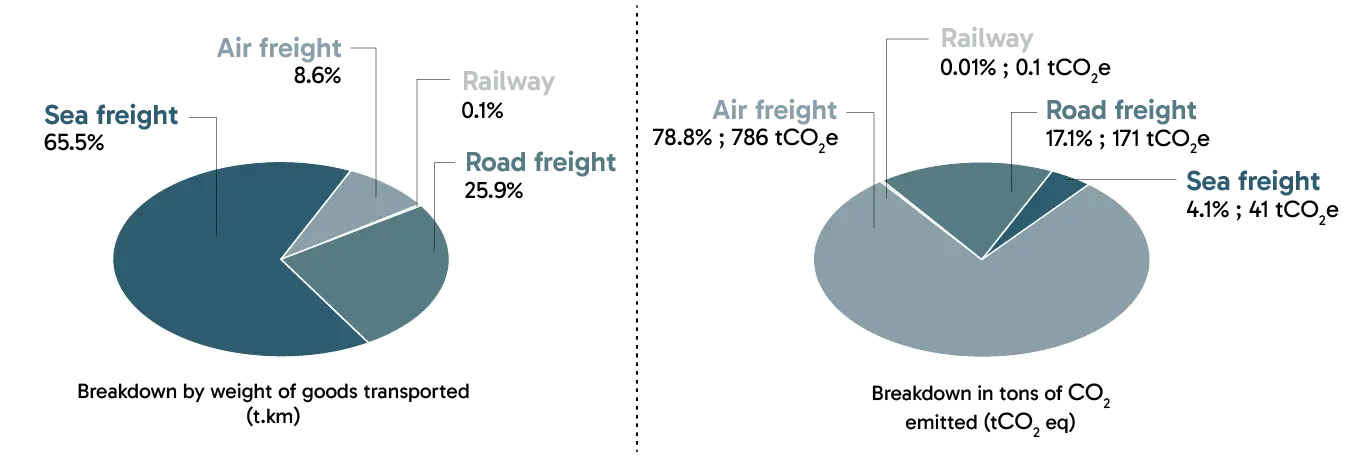
The main mode of transport used by Altyor is sea freight, which represents 65.5% of our modes of transport (based on the weight of goods transported). Although air freight accounts for only 8.6% of our transport modes, it is responsible for 78.8% of our greenhouse gas emissions.
How can we improve our carbon footprint?
Altyor has voluntarily completed its carbon footprint for all three scopes in 2024 and has been carrying out this exercise since 2020. Thanks to this assessment we have become aware of the improvements that are needed and the levers that need to be applied. The company would like to carry out this assessment on a regular basis in order to analyze the effects of the actions it has implemented.
- automate the production of our GHG report
- define reduction objectives
- reduce energy consumption through the implementation of best practices on site
- maximize the recycling of resources and disposing of waste appropriately
- use the least CO2 intensive transportation of goods and people
- design sustainable and repairable products through proven technology choices, intelligent design and a robust qualification process
- optimize the energy consumption of products by selecting appropriate technologies or components and by improving operating and standby modes
- promote product and packaging sobriety by designing products with a low carbon impact
- organize the end-of-life of products through our recycling channels
“Altyor was selected by Bpifrance and Ademe to join the Decarbonation gas pedal, with the aim of defining its low-carbon transition plan and implementing it via the “ACT* Pas à Pas” approach.”
 *ACT : Assessing low Carbon Transition initiative